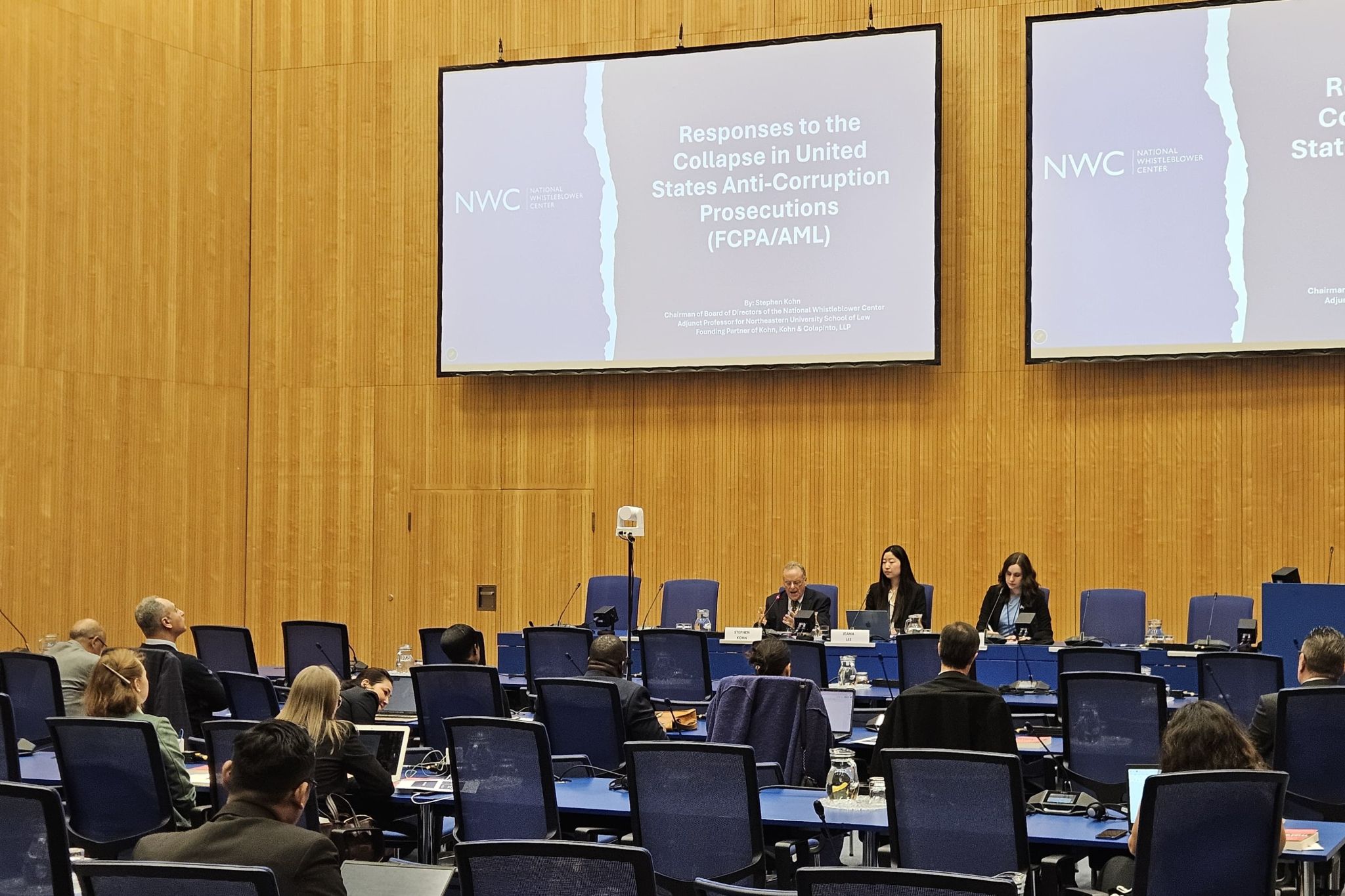
On October 21, 2026, the National Whistleblower Center hosted a side-event at the 13th Conference of the Parties to the UN Convention against Transnational Organized Crime (UNTOC COP13). The panel examined how anti-corruption advocates can promote cross-border cooperation and use whistleblower rewards to detect and deter transnational financial crimes, including money laundering and illegal offshore banking.
Eliza Lockhart, a senior fellow at the Royal United Services Institute, opened the discussion by highlighting several major transnational financial crime cases. Each of these cases depended on critical information from a whistleblower.
Lockhart claimed that the conventional assumption that whistleblowers should be acting purely out of altruism was defunct. Instead, she established that whistleblowers should be treated like any other intelligence source, and that financial rewards are necessary given the massive risks whistleblowers take on their lives and careers.


Lockhart concluded her segment by summarizing general findings from her research, “The Role of Financial Rewards for Whistleblowers in the Fight Against Economic Crime”. First, whistleblower rewards programs have a cumulative effect when positive results encourage more people to come forward. Next, programs are complicated and need to be tailored to specific legal and cultural contexts in each country. Finally, rewards programs need constant monitoring to remain effective.
The panel then turned to Stephen Kohn, a leading whistleblower attorney and Chairman of the National Whistleblower Center. Kohn pivoted the focus to the United States backtracking on the enforcement of transnational whistleblower laws such as the Foreign Corrupt Practices Act (FCPA).
Kohn called that unacceptable, pointing to the numbers. FCPA recoveries reached around $450 million between 2021 and 2022, and some years exceeded $1 billion. An estimated 40% of these cases directly involved a whistleblower, and another 20% involved media findings that may have originated from a whistleblower. Over $17 billion in sanctions were returned to foreign agencies that assisted with FCPA investigations in the past decade. Many of these countries leaned on the FCPA because they lacked effective domestic anti-corruption laws.
Despite the challenges surrounding the end of FCPA enforcement, Kohn remains optimistic about other countries stepping up to fill the enforcement gap. The United Kingdom’s HM Revenue and Customs has taken the initiative to create a reward program modeled on the IRS program, and their Serious Fraud Office is also moving in the same direction.
Kohn called on countries to update their anti-corruption laws to align with the US FCPA. He also urged them to cooperate on transnational crime prosecutions and to reinvest recovered funds into anti-corruption work.
Despite current global challenges, the message expressed by both speakers was clear: countries must rise to the occasion and cooperate together to tackle transnational crime.