
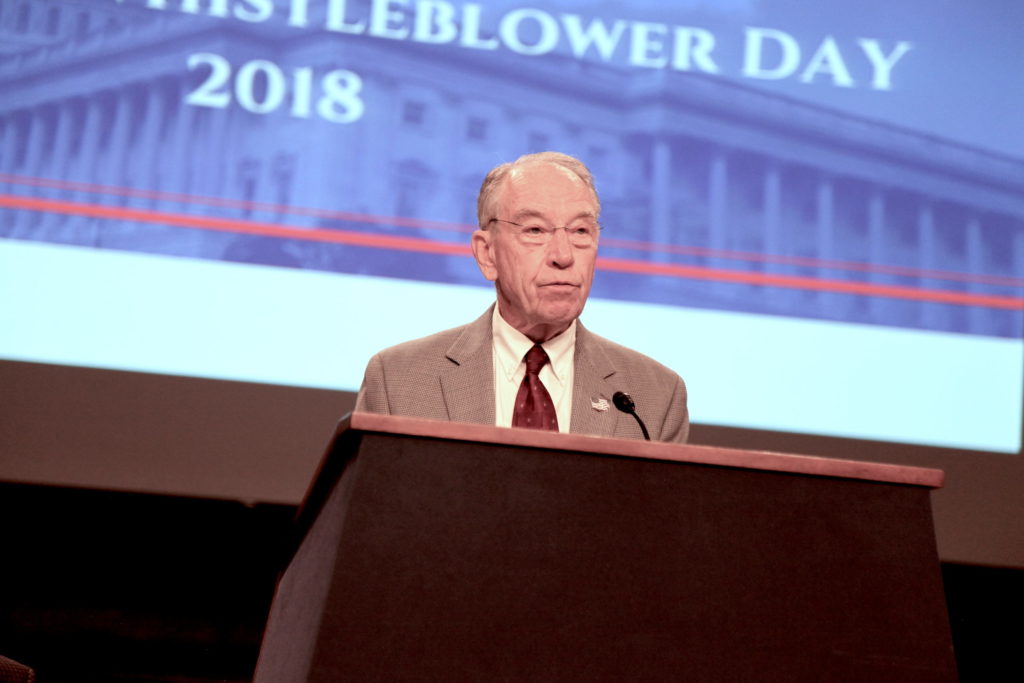
Sen. Chuck Grassley (R-Iowa) is calling on the Office of Personnel Management (OPM) to revise a proposed government-wide nondisclosure agreement, warning that the draft form could discourage federal employees from reporting waste, fraud, and abuse.
On May 27, OPM, the federal government’s chief human resources agency and personnel policy manager, published a notice seeking public comment on a proposed nondisclosure agreement for use by federal agencies with new and existing employees. According to OPM, the proposed form is intended to standardize confidentiality obligations across the federal government and protect non-public, confidential and proprietary information obtained through official duties.
Grassley, who chairs the Senate Judiciary Committee and co-founded the Senate Whistleblower Protection Caucus, warned that the draft does not go far enough to ensure federal employees understand that the agreement cannot override their whistleblower rights. In a letter to OPM Director Scott Kupor, Grassley urged the agency to update the draft NDA to include the full anti-gag provision required by federal law. Grassley also framed the issue as one implicating federal employees’ constitutional rights.
“A fundamental precept of whistleblowing is the First Amendment,” he wrote.
In the letter, which was also submitted as a public comment, Grassley argued that OPM’s draft form contains only a partial anti-gag provision – it recognizes employees’ rights to make disclosures to Congress and the Inspectors General but does not expressly include disclosures to the Office of Special Counsel. He said that omission must be corrected before the form is finalized.
Grassley also objected to the placement of the anti-gag language. The draft places the provision near the beginning of the agreement, but Grassley urged OPM to move it to the end of the form, near the employee’s signature. Including the provision there, he wrote, would give employees “the mental assurance they are not signing away their whistleblower rights.”
Grassley pointed to the history behind federal anti-gag protections, including the case of Pentagon whistleblower Ernie Fitzgerald, who Grassley said was pressured in 1987 to sign a government-wide NDA that could have prevented him from giving information to Congress. Grassley later introduced an anti-gag provision to prevent agencies from using NDAs to override whistleblower rights, a protection later codified in the Whistleblower Protection Enhancement Act of 2012.
The following day, Grassley delivered a Senate floor speech criticizing the proposal and emphasizing the distinction between unlawful leaks and protected whistleblower disclosures.
“Legally protected whistleblower disclosures aren’t leaks,” he said. “Legally protected whistleblower disclosures aren’t unauthorized disclosures.”
Grassley said Congress should monitor the use of the NDA if OPM implements the form. “If the draft nondisclosure form is implemented, Congress must do oversight to ensure it’s not used inappropriately,” he said.